Fast navigation
 Whatsapp:+8613811510145
 xhmineral@ytxinhai.com

Fast navigation
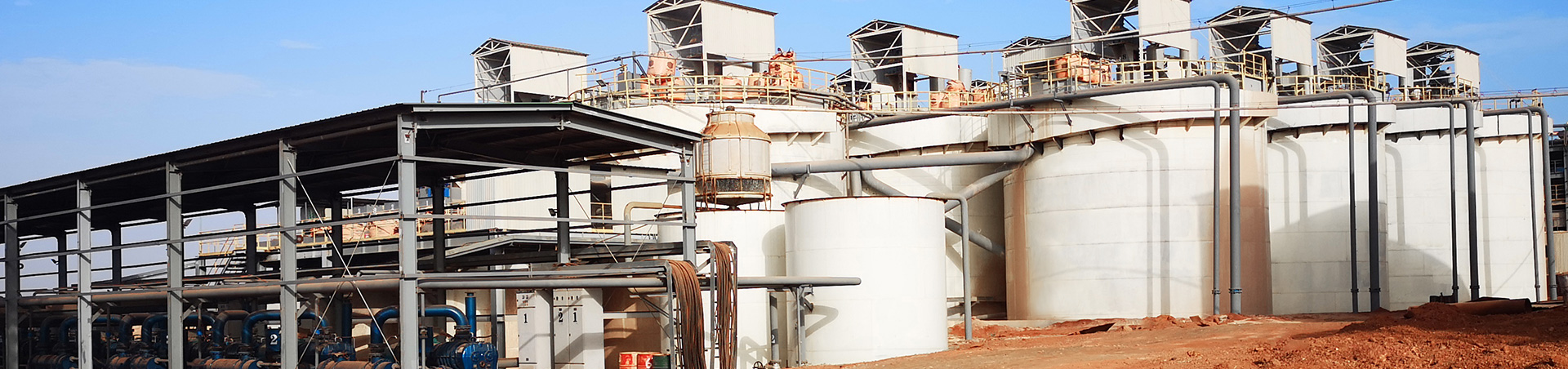
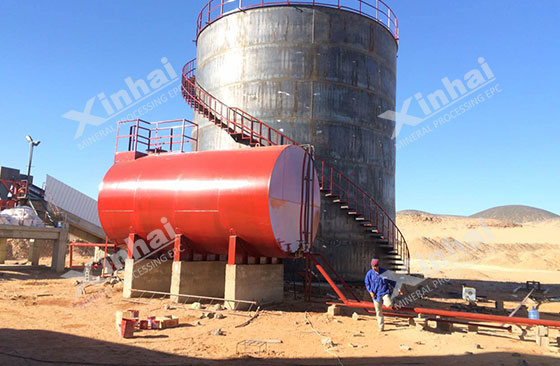
Gold leaching is an important part of gold smelting, among which CIP (carbon-in-pulp), CIL (carbon-in-leach) and heap leaching are the three most widely used processes. They are suitable for different types of gold ores and have different economic and environmental impacts. This article will analyze these three gold leaching methods in detail and explore their process optimization and development trends.
2025-02-17 XinHai (views 2244)
Gold leaching is an important part of gold smelting, among which CIP (carbon-in-pulp), CIL (carbon-in-leach) and heap leaching are the three most widely used processes. They are suitable for different types of gold ores and have different economic and environmental impacts. This article will analyze these three gold leaching methods in detail and explore their process optimization and development trends.
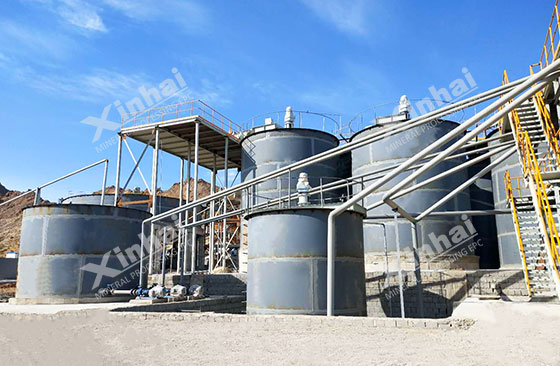
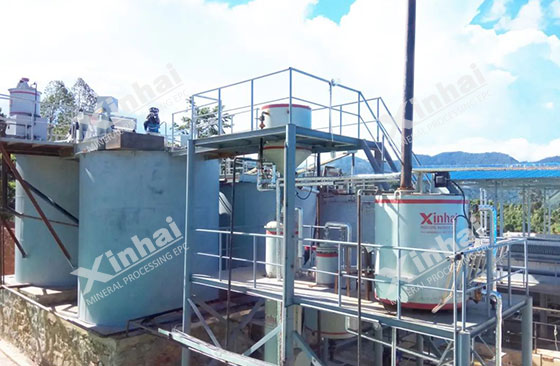
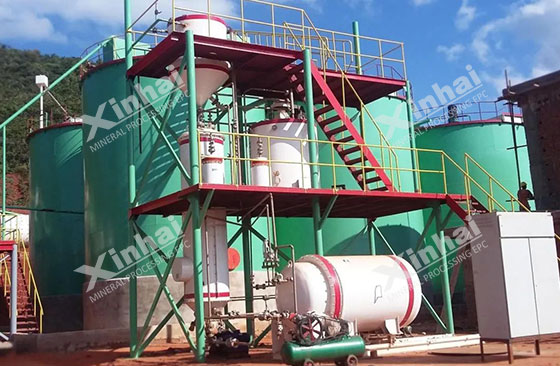
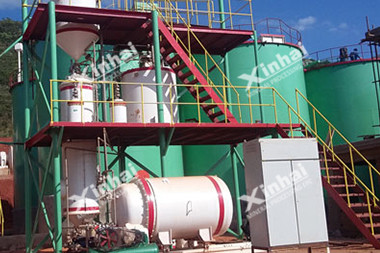
The CIP (Carbon-in-Pulp) process refers to mixing the crushed and ground ore pulp with a cyanide solution to dissolve the gold to form a complex, and then adsorbing the dissolved gold through activated carbon. Subsequently, the gold is desorbed, electrodeposited and finally smelted into gold ingots.
CIL (Carbon-in-Leach) is similar to CIP, but the difference is that the leaching and adsorption processes of CIL are carried out simultaneously in the same equipment, while CIP leaches first and then adsorbs. This difference makes the gold CIL process have a higher gold recovery rate and is suitable for some refractory ores containing natural carbon.
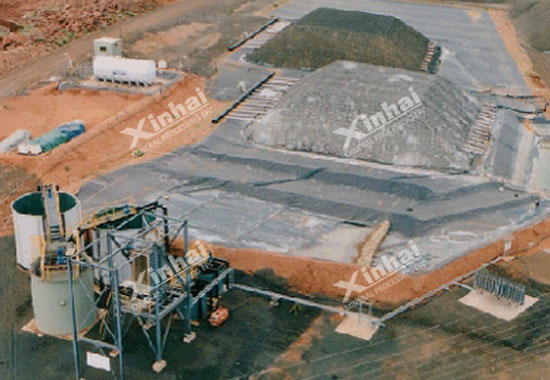
The heap leaching method is suitable for low-grade oxidized gold ores. The ore is crushed to a suitable particle size and then piled up, and the cyanide solution is sprayed to dissolve the gold and infiltrate along the pile to the bottom collection system, and then the gold is recovered by adsorption or displacement. Heap leaching has low investment and is suitable for large-scale mines, but the gold leaching rate is usually lower than CIP/CIL process.
Crushing&Grinding: Generally, the ore is ground until 80% passes through a -74μm (200 mesh) sieve.
Cyanide Leaching: In an alkaline environment (pH 10-11), sodium cyanide solution is added to dissolve the gold.
Carbon Adsorption: Activated carbon adsorbs and dissolves gold, CIP uses series adsorption, and CIL uses direct adsorption.
Desorption and Electrodeposition: Desorb gold by heating or chemical methods, and then deposit it by electrodeposition.
Smelting: The electrodeposited gold mud is smelted at high temperature to obtain gold ingots.
Ore crushing: crush the ore to 6-12mm to ensure the permeability of the leaching solution.
Heap leaching site construction: lay an impermeable layer to prevent cyanide from contaminating groundwater.
Spray leaching: spray the cyanide solution onto the ore pile, and the gold will permeate along the ore pile after dissolution.
Gold recovery: recover the gold in the solution through activated carbon adsorption or zinc powder replacement.
Wastewater treatment: use oxidation or biodegradation to treat cyanide-containing wastewater.
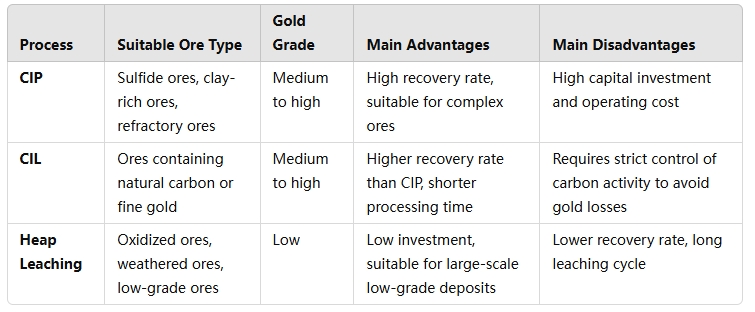
CIP/CIL: large investment, but high gold recovery rate, suitable for high-grade mines.
Heap leaching: small investment, low operating cost, but low gold leaching rate (50%-80%), suitable for low-grade mines.
CIP/CIL cyanide-containing wastewater needs to be treated by oxidative degradation or activated carbon adsorption. The risk of cyanide penetration in heap leaching is high, and strict anti-seepage measures are required. In recent years, cyanide-free leaching agents (such as thiosulfate and chlorination) are being developed to reduce environmental pollution.
Use ultrafine grinding (-20μm) to increase the exposure of gold and improve the leaching rate. Research new activated carbon to improve gold adsorption capacity and reduce carbon loss. Pre-oxidation technology (such as high-pressure oxidation and bacterial oxidation) is used for pretreatment of difficult-to-leach gold ores to improve leaching effects.
Use ammonia oxidation-thiosulfate method to replace cyanide, improve leaching efficiency and reduce environmental pollution. Use column leaching test to optimize the spraying scheme, control the flow rate of the leaching solution, and improve the gold recovery rate. Research biometallurgical technology to improve the heap leaching recovery rate of difficult-to-treat gold ores.
The above is a brief introduction to the gold leaching process: CIP, CIL and heap leaching process. Each process has its own advantages and is suitable for different types of gold resources. If you are looking for gold leaching process and equipment, or want to learn about efficient gold leaching equipment, please continue to pay attention to our website, we will provide more cutting-edge industry information!
Copper is one of the most widely used metals in the world. It is widely used in fields such as electrical and industrial machinery. The extraction of copper is a complex process involving multiple stages from mining to refining. Among them, the flotation process plays an important role in the extraction of copper metal from copper ore. Flotation is widely used in the treatment of various ores. It mainly relies on the difference in the properties of the mineral surface to selectively recover valuable copper-containing minerals while removing gangue minerals. This article will introduce the flotation process of different copper ores to help you understand the flotation process of copper ores.
Quartz ore is an important non-metallic mineral. It is primarily composed of silicon dioxide (SiO₂). High-purity quartz is a key raw material in industries like glass, ceramics, photovoltaics, and semiconductors and so on. Natural quartz ore often contains impurities such as iron, aluminum, mica, and feldspar, these impurities affect quality and usability of quartz sand. Mineral processing is essential technology to purify quartz ore. The selection and efficiency of quartz sand mineral processing equipment directly impact purification results and product costs. This article will introduce the types and selection of quartz ore processing equipment.





 Whatsapp:+8613811510145
  xhmineral@ytxinhai.com
  Online Inquiry

 Get Quote
 Online Inquiry
 Leave Message
 Send Email

 Consult
 Message
 Email
Email
 Whatsapp
